Until the Summer of 1993, my parents allowed me to watch horror films. For instance, I remember watching the Edited for Television version of Friday the 13th (1980) on Commander USA’s Groovie Movies.
Later, I visited the neighborhood video store. I was mesmerized by the VHS cover art of the R-rated theatrical cut on the shelf.
In the Autumn of 1999, I discovered there was a Japanese Video Laserdisc released by Warner Brothers with extra footage. The International Cut was the unedited version of the film with 11 seconds of gory special effects.
This information sparked my obsession with alternate cuts of films. Soon, I located an unauthorized LD>VHS copy from a Canadian tape trader.
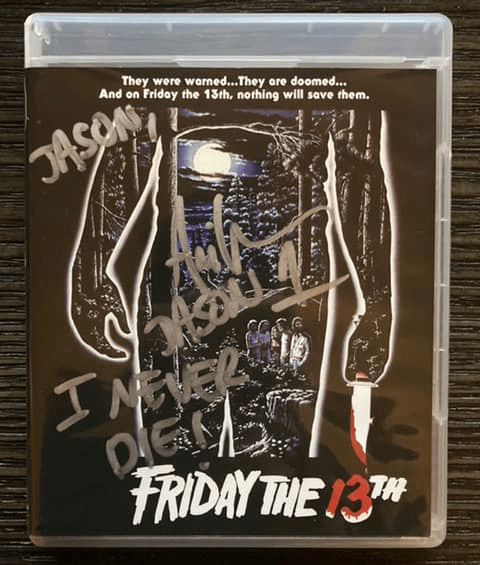
On September 18, 2021, I met Ari Lehman (First Jason) at a horror convention in Quincy, Illinois. Lehman was very friendly. I asked him if he would personalize my copy of the Scream Factory Blu-Ray release to “Jason.” Also, Lehman insisted on signing one of the photos he provided at the table for no extra charge.
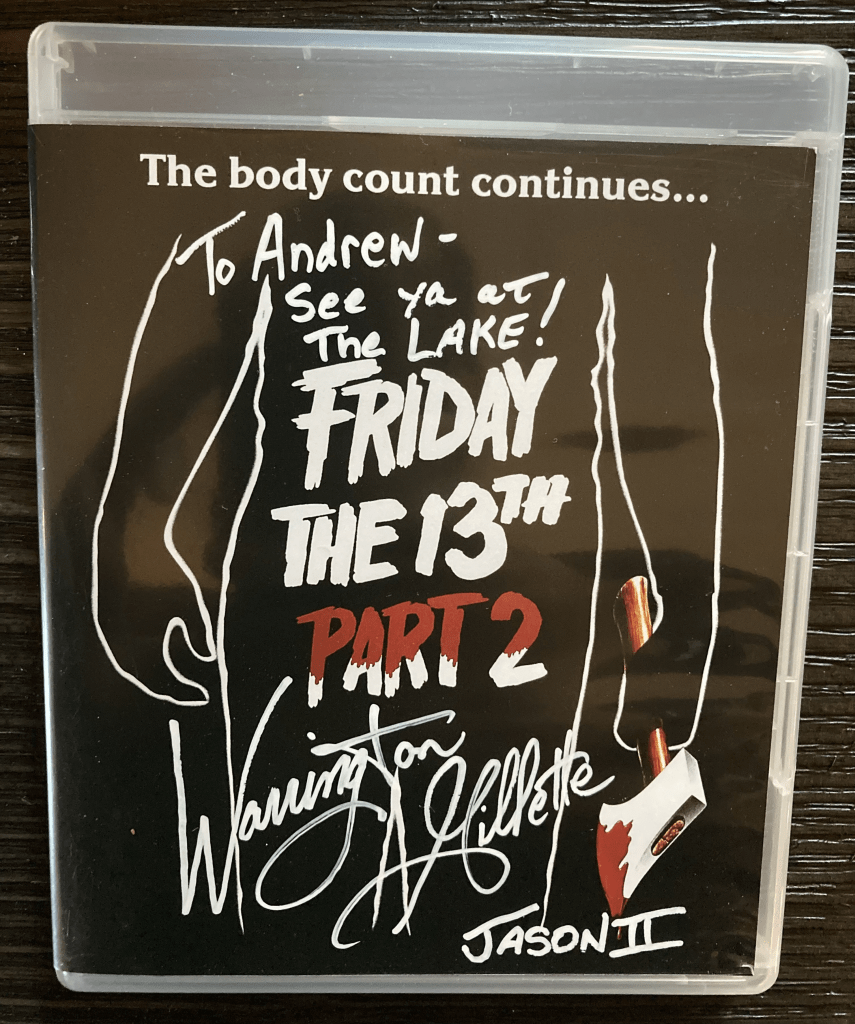
On October 7, 2023, my family met Warrington Gillette (Second Jason – Unmasked) at a horror convention in Hannibal, Missouri.
After we exchanged pleasant introductions, Gillette talked about his journey from Florida. He was deeply concerned about how the United States was becoming a dangerous place to raise a family. I thought Gillette was going to share a story about something that happened during his trip to Missouri. Instead, his concerns were fixated on a general worry about violence and criminal activity in the United States. I acknowledged his concerns and reassured him that the Tri-State area has been a wonderful place to raise my family. But I did not know how to continue the conversation.
Instead, I changed the topic and mentioned Part 2 was my favorite film in the series. I asked him if he would personalize my copy of the Scream Factory Blu-Ray release. Enthusiastically, Gillette took a group selfie with my family, and he invited us to follow him on social media.
Overall, it was a pleasant but unusual interaction.
Yes, Friday the 13th Part 3 (1982) introduced the iconic hockey mask disguise for Jason Voorhees. But I am not a huge fan of the third installment. The movie includes too many campy elements like the “Tommy Chong” doppelganger and Harry Manfredini’s ’70s-inspired disco theme.
Yet, I am intrigued by one of the early drafts for Part 3. The female survivor from the earlier film is confined to a psychiatric hospital while Jason hunts her down. Still, the plot sounded way too close to Halloween II (1981).
The experience of watching James Cameron’s The Terminator(1984) and Russell Mulcahy’s Highlander (1986) as a double feature is uncanny.
A few examples of similarities between the two movies:
many scenes in parking garages and alleys
blue electrical effect across vehicles and buildings
the hero being doubted in a police interrogation about his true identity
flashbacks of the hero’s past scattered throughout the narrative
the villain interacting with hotel employees for comic relief
the hero’s confession which leads to a love scene in a dark bedroom
I would argue that the producers of Highlander used the screenplay template and visual style from The Terminator. But Highlander added some details which makes their imitation of The Terminator unique.
For example, Sean Connery playing a Spanish-Egyptian mentor with a Scottish accent and Queen composing the musical soundtrack.
Of course, the producers of The Terminator were forced to officially acknowledge the works of Harlan Ellison. They recognized the similarities with The Outer Limits episodes “Soldier” and “Demon with a Glass Hand.”
Synopsis: A parody of Lethal Weapon, two unlikely police officers investigate murders, drug smuggling, and Wilderness Girl cookies.
Director: Gene Quintano
Cast: Emilo Estevez (The Breakfast Club,The Mighty Ducks)
Samuel L. Jackson (Pulp Fiction)
Jon Lovitz (Saturday Night Live)
Tim Curry (Rocky Horror Picture Show,Home Alone 2: Lost in New York)
Kathy Ireland (Alien From L.A.)
William Shatner (Star Trek)
Alternate Versionsof the Film:
VHS | LASERDISC | DVD | U.S. Theatrical Cut (83-min.)
NBC | Extended TV Cut which includes 16 minutes of extra footage and extended scenes. Original Airdate: March 10, 1996.
JAPANESE LASERDISC | Extended TV Cut (93-min.) which includes 10 minutes of extra footage and extended scenes. As of July 2023, this is the only official home video release to contain the TV Cut on any format.
TBS | Extended TV Cut (90-min.) which includes 10 minutes of extra footage and extended scenes. But the film has been time-compressed. Some lines of dialogue have been censored or removed when compared to the Extended Cut on Japanese Laserdisc.
Extra Footage, Altered Footage, and Deleted Footage:
EXTRA FOOTAGE – NBC: Wes Luger spends time with his family and talks about his upcoming retirement. (3:28)
EXTRA FOOTAGE: Christopher Lambert drives up in a passing vehicle and informs Luger that he has a telephone call. (0:23)
EXTRA FOOTAGE: Luger asks the police captain how much time he has to solve the murder case. (0:50)
ALTERED FOOTAGE: Colt’s line “I realized how neglected she felt the night she shit in my shoes,” has been changed to “I realized how neglected she felt the night she crapped in my shoes.”
DELETED FOOTAGE: Phil Hartman’s penis joke has been removed.
ALTERED FOOTAGE: Colt’s line “Tight ass,” has been changed to “Tight head.”
EXTRA FOOTAGE / ALTERNATE TAKE: The hotel clerk insults Colt and Luger pulls out several items before showing the t-shirt. (0:59)
ALTERED FOOTAGE: The F.B.I. Agent’s line “Get your shit together, will you! That’s Becker, 403,” has been changed to “Get your act together, will you. That’s Becker, 403.”
EXTRA FOOTAGE: Colt pulls himself up onto the damaged piano, and Luger and Irv discuss the crime scene. (0:32)
EXTRA FOOTAGE: Luger and Colt have a confrontation. (4:30)
ALTERED FOOTAGE – NBC: Outside the Wilderness Girls headquarters, Colt’s voice-over revealing his connection to Mortars has been removed.
EXTRA FOOTAGE – NBC: Inside the Wilderness Girls headquarters, Colt reveals his connection to Mortars. (0:20)
EXTRA FOOTAGE – NBC: Colt decides to take the stairs. (0:20)
ALTERED LINE: Colt’s line “No, waking up without my penis, is my worst nightmare,” has been changed to “No, waking up without mypiano, is my worst nightmare.”
EXTRA FOOTAGE – NBC: Luger’s son is working on a science project. (0:30)
DELETED FOOTAGE – NBC and TBS: Colt’s moonbeam walk has been removed.
EXTRA FOOTAGE – NBC: Colt and Destiny escape in a car. (0:30)
EXTRA FOOTAGE: Colt searches the main floor of Luger’s house. (1:12)
ALTERED FOOTAGE: Colt and Luger’s conversation in the bathroom has been altered. The change was made to avoid showing the toilet. Luger’s line “Nothing. Taking a shit,” has been changed to “Nothing. Taking a crap.”
DELETED FOOTAGE – NBC and TBS: Luger’s lines “Handled her hooters?” and “You parked the pink Cadillac?” have been removed.
EXTRA FOOTAGE – NBC: Colt receives assistance with the locked door at the warehouse. (0:20)
EXTRA FOOTAGE – NBC: Colt sneaks around the warehouse. (0:18)
ALTERED FOOTAGE: Luger’s line “It’s personal. But what’s important is I’m here,” has been shortened to “What’s important is I’m here.”
EXTRA FOOTAGE: Colt has a near-death, out of body experience. (1:37)
EXTRA FOOTAGE – NBC: Luger’s wife wants to introduce Wes to her new friend. (0:21)
Between 1979-1981, Universal decided to re-edit a few Battlestar Galactica episodes into feature-length films for international theatrical release. Additionally, the studio re-edited the original series into television movies (telefilms or telemovies) for local broadcast in the United States.
Universal released Battlestar Galactica (a.k.a. Saga of a Star World), Mission Galactica: The Cylon Attack, and Conquest of the Earth on VHS and Video Laserdisc. Later, the studio released six of the twelve telefilms in Europe on VHS including War of the Gods, Curse of the Cylons, Murder in Space, Space Prison, Space Casanova, and The Phantom in Space.
Moreover, the individual 1-hour episodes were paired together, but the continuity reflected a single 2-hour narrative. Most of the twelve telefilms included extra scenes, voice-over narration, and stock footage.
SAGA OF A STAR WORLD
The premiere episode aired as the ABC Sunday Night Movie on September 17, 1978. The episode was re-edited and released in European and Canadian theaters with a slightly alternate ending on July 8, 1979.
In 1981, the 2 1/2-hour Telefilm was broadcast. The story arc was a re-edit of the International Cut but included the original ABC TV Movie ending.
Later, the ABC TV Movie broadcast was re-edited as three 1-hour episodes for syndicated airings on the Sci-Fi Channel.
LOST PLANET OF THE GODS
The episodes aired as two 1-hour episodes on September 24, 1978 & October 1, 1978. It was re-edited as a 2-hour Telefilm with extra footage.
THE GUN ON ICE PLANET ZERO
The episodes aired as two 1-hour episodes on October 22, 1978 & October 29, 1978. It was re-edited as a 2-hour Telefilm with extra footage.
THE LIVING LEGEND
The episodes aired as two 1-hour episodes on November 26, 1978 & December 3, 1978. It was re-edited as a 2-hour Telefilm with extra footage.
MISSION GALACTICA: THE CYLON ATTACK
[The Living Legend | Fire in Space]
The episodes aired as three 1-hour episodes on November 26, 1978 & December 3, 1978 | December 17, 1978. It was re-edited and released in European and Canadian theaters in 1979.
CURSE OF THE CYLONS
[The Magnificent Warriors | Fire in Space]
The episodes aired as two 1-hour episodes on November 12, 1978 & December 17, 1978. It was re-edited as a 2-hour Telefilm with extra footage.
WAR OF THE GODS
The episodes aired as two 1-hour episodes on January 14, 1979 & January 21, 1979. It was re-edited as a 2-hour Telefilm with extra footage.
MURDER IN SPACE
[The Young Lords | Murder on the Rising Star]
The episodes aired as two 1-hour episodes on November 19, 1978 & February 18, 1979. It was re-edited as a 2-hour Telefilm with extra footage.
GREETINGS FROM EARTH
The episode aired as one 2-hour episode on February 25, 1979.
Although the Telefilm version does not include extra footage, it does have the standard Telefilm opening credits. Later, the episode was re-edited as two 1-hour episodes for syndicated airings on the Sci-Fi Channel.
SPACE PRISON
[The Man With Nine Lives | Baltar’s Escape]
The episodes aired as two 1-hour episodes on January 28, 1979 & March 11, 1979. It was re-edited as a 2-hour Telefilm with extra footage.
EXPERIMENT IN TERRA
[Experiment in Terra | The Return of Starbuck]
The episodes aired as two 1-hour episodes on March 18, 1979 & May 4, 1980. It was re-edited as a 2-hour Telefilm with extra footage.
SPACE CASANOVA
[The Long Patrol | Take the Celestra]
The episodes aired as two 1-hour episodes on October 15, 1978 & April 1, 1979. It was re-edited as a 2-hour Telefilm with extra footage.
THE PHANTOM IN SPACE
[The Lost Warriors | The Hand of God]
The episodes aired as two 1-hour episodes on October 8, 1978 & April 29, 1979. It was re-edited as a 2-hour Telefilm with extra footage.
CONQUEST OF THE EARTH
[Galactica Discovers Earth | The Night the Cylons Landed]
The episodes aired as five 1-hour episodes on January 27, 1980 | February 3, 1980 | February 10, 1980 | April 13, 1980 | April 20, 1980. It was re-edited and released in European theaters in 1981.
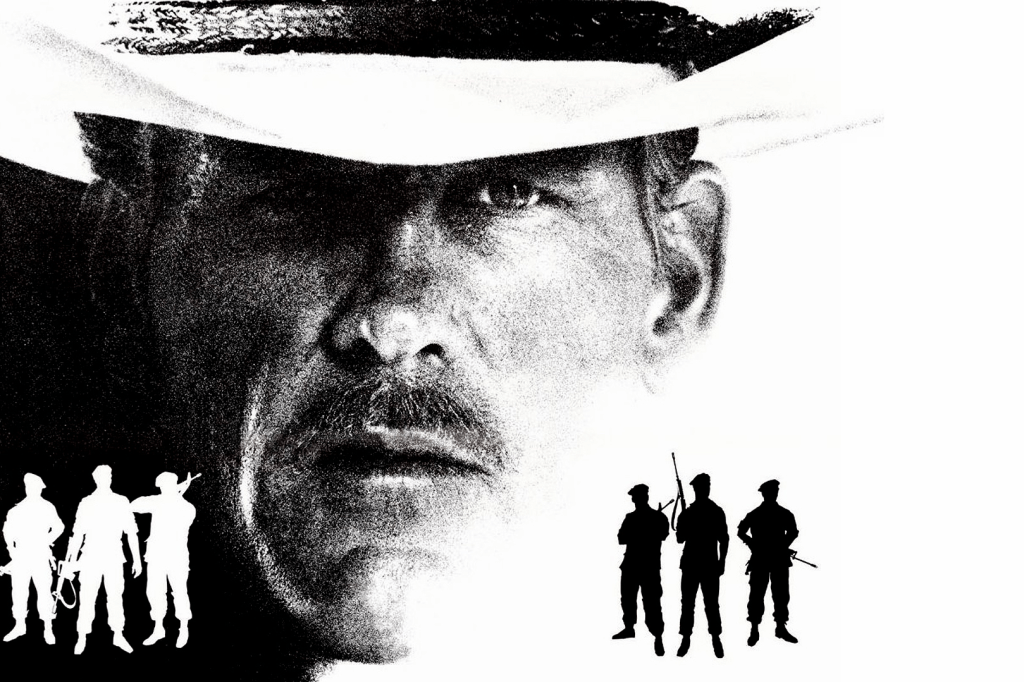
Synopsis: A Texas Ranger protects a small border town from a Mexican drug cartel as a clandestine U.S. military unit arrives to carry out a secret mission.
Director: Walter Hill (The Warriors,48 Hrs.)
Music: Jerry Goldsmith (Alien,Gremlins)
Cast: Nick Nolte (48 Hrs., Tropic Thunder)
Powers Boothe (Red Dawn, 24)
Maria Conchita Alonso (The Running Man,Vampire’s Kiss)
Rip Torn (Men in Black,Dodgeball: A True Underdog Story)
Michael Ironside (Total Recall, Highlander II: The Quickening)
Clancy Brown (Highlander, Spongebob Squarepants)
William Forsythe (Dick Tracy, The Devil’s Rejects)
Larry B. Scott (Revenge of the Nerds)
Tommy “Tiny” Lister (No Holds Barred,The Dark Knight)
Opinion: Extreme Prejudice was a box-office failure and suffers from some pacing and editing issues. The movie is a wonderful homage to The Wild Bunch (1969) and a spiritual predecessor to The Way of the Gun (2000).
Trivia: It is rumored that almost forty minutes of footage was removed from the final cut including a subplot with Andrew Robinson (Hellraiser,Star Trek: Deep Space Nine) as a government agent.
Originally Written for English Film Studies in 2002
Introduction to English Film Studies:
In the Autumn of 2002, I analyzed several movies with their respective literary source material.
Francis Ford Coppola’s Apocalypse Now (1979) with Joseph Conrad’s novella Heart of Darkness (1899)
Todd Field’s In the Bedroom (2001) with Andre Dubus’ short story Killings (1979)
Tod Browning’s Dracula (1931) with Bram Stoker’s epistolary novel Dracula (1897).
I wrote dozens of research papers in college. But this was one of my favorite assignments. We were allowed to choose which Dracula adaptation that we wanted to research for the final writing assignment.
For many years, I thought this article was lost forever. Recently, I recovered the document on a long-forgotten hard drive.
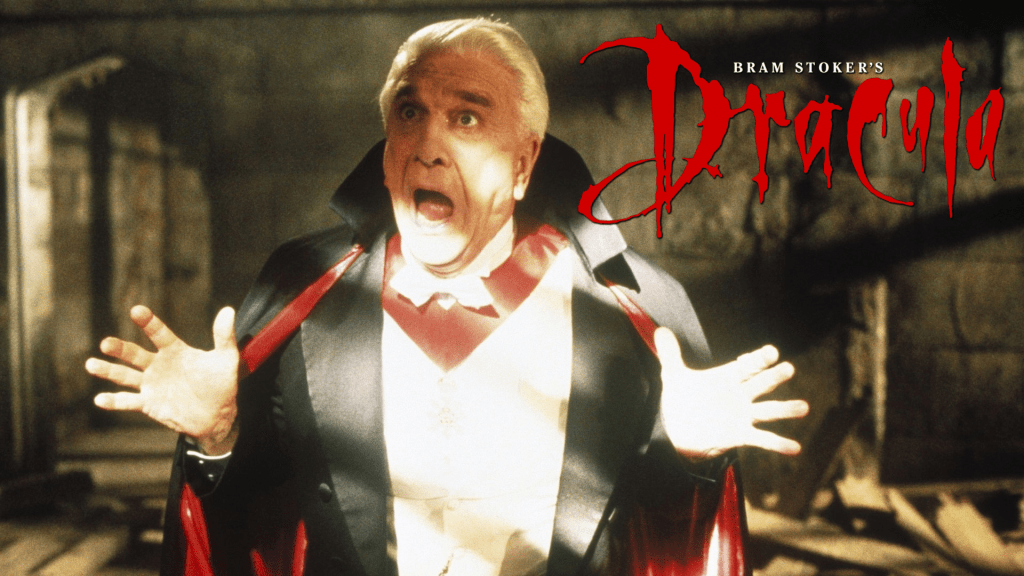
Dracula: Dead and Loving It
“The children of the night. What a mess they make.” – Count Dracula
1995, USA. Director: Mel Brooks Screenplay: Mel Brooks, Rudy DeLuca, and Steve Haberman. Based on a story by Rudy DeLuca and Steve Haberman. Based on characters and situations created by Bram Stoker. Cinematography: Michael D. O’Shea Editing: Adam Weiss
Cast: Count Dracula ……… Leslie Nielsen R.M. Renfield ……….. Peter MacNicol Jonathan Harker …… Steven Weber Mina Murray ……….. Amy Yasbeck Van Helsing ………….. Mel Brooks Lucy Westenra ……… Lysette Anthony Jack Seward ………….. Harvey Korman
Plot Summary: Renfield, a solicitor from London, travels to Transylvania and meets Count Dracula. Together, they conclude a business deal on an estate in England. Though, despite many warnings from the townspeople about the supernatural occurrences at Dracula’s castle, Renfield meets the Count. Soon, Renfield is under Dracula’s spell and accompanies the Count to London. While Renfield is incarcerated at a sanitarium, Dracula begins to integrate himself into London’s social class and seduces Dr. Seward’s young ward, Lucy Westenra. When Lucy becomes heavily fatigued, Seward calls in Dr. Abraham Van Helsing, a specialist in rare diseases, as well as “theology, philosophy, and gynecology.” Nevertheless, Van Helsing believes that Lucy has fallen prey to a vampire. He enlists the aid of Seward and his future son-in-law, Jonathan Harker, to free Lucy from eternal damnation. Before long, Dracula sets his sight on Jonathan’s fiancée, Mina. Setting up an elaborate trap at a ball, Van Helsing reveals that Dracula is the vampire. Also, Renfield is exposed as the Count’s accomplice. Dracula kidnaps Mina and plans to make her his bride. Van Helsing compels Seward to release Renfield, who unwittingly leads Van Helsing to the Count’s secret lair. In an epic struggle of good versus evil, Dracula is defeated.
Connections to the Original Novel: Mel Brooks respects the tradition of keeping the characters and historical settings of the novel. Renfield is a patient at Dr. Seward’s sanitarium who is driven insane by Dracula’s supernatural powers. Count Dracula is a vampire from Transylvania who purchases an estate next to Seward’s sanitarium. He seduces Lucy Westenra and Mina Murray. Lucy is a young and beautiful woman who falls prey to Dracula’s spell and becomes a vampire herself. Van Helsing is a doctor who believes in vampires and convinces the other characters of the Count’s true identity. Jonathan Harker is engaged to Mina and must join the fight against Dracula to save the woman he loves.
Thematic Analysis: Bram Stoker used a distinctive narrative style in his novel which utilized several narrators. For example, the use of different narrators offered credibility. There was a sense that these people belonged to a community that needed protecting from Dracula’s evil. Of course, Brooks used an unbiased and cinematic third person format. The film begins with Renfield’s point of view, but quickly changes to Count Dracula and Van Helsing’s viewpoint. Although Brooks draws heavily upon satirizing Stoker’s novel, there are many differences about the themes explored in the film. As a result, the alteration of the source material changed the characters’ motives and feelings about the community around them.
The theme of science and technology is presented differently in Stoker’s novel and Brooks’ film. In the novel, for instance, Van Helsing heavily relied on his scientific background as a doctor. When he investigated the strange circumstances surrounding Lucy’s illness, he empirically observed the evidence. Eventually, he came to the conclusion that a vampire was involved in the young woman’s condition. This emphasized the vital need to use reason and logic as a means to work your way through a problem. Nevertheless, in Brooks’ film, Van Helsing briefly inspects Lucy’s neck. Quickly, he concludes that a vampire was responsible because modern science couldn’t explain the loss of blood in Lucy’s body. When Seward and Harker scoff at the idea, Van Helsing chastises the men for their ignorant reliance on science. It is clear that Brooks’ placed Van Helsing in charge of the group over Seward and Harker. The different viewpoint on science and technology in the film highlights the need to avoid empiricism. Van Helsing relies on supernatural possibilities. Ultimately, science is subordinate to faith and religion.
Nonetheless, the idea that religion and Christianity are powerful tools is still clear in the film. Although they are not infallible tools to defeat vampires, items like the crucifix and garlic can hold Dracula at bay. The weapons are the few physical items that are more reliable than science. It is the only way to temporary save Lucy from Dracula’s powers until redemption can found.
Nevertheless, the theme of redemption is handled very differently by Brooks. Stoker offered a sense of redemption for Dracula, while Brooks offered eternal destruction for Dracula. In the novel, for example, there was a “look of peace” on the Count’s face when Harker killed him. Conversely, in Brooks’ film, Dracula is not saved from his curse. The only hint of a possible redemption comes in the form of a “daymare.” After feeding upon Lucy’s blood, Dracula dreams that he has been cured. He can walk about in the daylight, if only momentarily. Yet, since this event is revealed as a dream, it is unclear whether Dracula would have found redemption. The vampire is obviously appalled by the notion of being a human and associating with the community. Hence, Brooks believes that redemption is something that evil doers do not want to achieve anyway.
Yet, this does not mean Brooks suggests that everyone is doomed to eternal damnation. The film does keep a sense of misguided and unintentional redemption. Since American audiences love individualism, Brooks used an anti-hero in the unlikely form of Renfield to defeat Count Dracula. In the novel, Stoker highlighted the importance of community. It was a group effort that led to the defeat of Dracula and his minions. Yet, in the film, because of Renfield’s obsession in pleasing Dracula, he searches for an escape route. He accidentally exposes the vampire to the sunlight and kills his master.
Ultimately, according to Brooks, redemption from madness is unexpected and not something a person can knowingly set out to achieve.
In the novel, madness was personified in Renfield’s character, while altruism was embodied by Harker. While Renfield still embodies the idea of madness in the film, Brooks does not include such personifications for Mina’s fiancé. Harker symbolizes guilelessness and skepticism. Although Harker knows that Lucy is dead, he is still unwilling to believe it. He almost falls for Lucy’s sexual advances toward him. Van Helsing’s knowledge of vampire lore saves the young man from Lucy. Van Helsing suggests that she must be evil because of her open sexuality and readiness to commit fornication.
The use of sexuality is one of the most important elements in any adaption of Stoker’s novel. Both the film and novel suggest that if a woman becomes voluptuous and sexually appealing, she is truly evil. She must be destroyed for her own good, and for the good of the community. Yet, Brooks slightly changes the use of sexuality in his film. Much like Tod Browning’s 1931 adaption, Brooks made Renfield effeminate. Renfield can’t escape from Dracula because he has unmanly qualities about him that prevent him from resisting the Count’s powers. In fact, Dracula does not even finish his mesmerizing speech before Renfield is under the Count’s control. Yet, when Renfield is around the voluptuous vampire women he does show an interest in them. Also, he becomes sexually aroused by Lucy when he is trying to rid her bedroom of the garlic. Thus, Lucy is already an alluring woman before her transformation as a vampire. For example, Lucy undresses outside on the terrace for the Count’s advantage although she is not a vampire yet. It is only then that Dracula exploits her sensuality and begins seducing her. Brooks suggests that already being alluring is what leads a woman to being “corrupted by the evil of a vampire.” All of this information is revealed quickly and without hesitation.
The withholding of vital details about Dracula’s true identity created tension and suspense in Stoker’s novel. In fact, Dracula disappeared in the middle part of the novel. Rather, the focus was on Van Helsing and the committee’s effort to unravel the case of the mysterious deaths. Although Dracula’s mysterious powers are limited, Brooks does not hide the fact that the Count possesses mind control abilities. In fact, Brooks makes it clear from the beginning that Count Dracula is a vampire. For example, Dracula transforms into a bat and leaves his estate to seduce Lucy. Later, Van Helsing arranges an elaborate trap to expose that Dracula has no reflection in a mirror. The startling revelation is to set up the final confrontation between good and evil. It is not to inform the audience that Dracula is the vampire. Thus, the suspense surrounding Dracula’s identity is not included in Brooks’ film.
Overall, Brooks seemed to be ridiculing Stoker’s novel and other well-known Hollywood adaptations. But he succeeded in crafting together a delightful comedy about the characters and situations created nearly a century ago.
The book of Genesis is a narrative and genealogical history of early mankind. Moses describes the origin of life and how the Almighty God created everything that exists…except Himself, of course…using the power of the Holy Spirit. In other words, God made the world from nothingness to show his unconditional love. Nonetheless, the Fall of Man demonstrated that God’s love included unusual and unexplained conditions.
For example, God created the Garden of Eden which contained the Tree of Knowledge of Good & Evil. He appointed Adam as the caretaker with the strict mandate to abstain from eating from the special tree. (Genesis 2:15-17)
Later, God realized Adam was lonely. He created “every beast of the field, and every fowl of the air.” Then, the newly created dependent was assigned the task of naming the animals. (Genesis 2:18-19)
Yet, it is unclear if Adam simply classified the generic animal groups or named the 1,200,000 species known to exist.
Soon, Adam realized that he did not have a counterpart in nature. Adam takes a nap while God creates a woman. (Genesis 2:20-21)
It seems that mankind’s prime directive was to “be fruitful, and multiply, and replenish the earth.” (Genesis 1:28) But why did God wait to create Eve?
Additionally, the scriptural origin of Woman establishes a sexist and patriarchal system. The males always hold the primary power in roles of political leadership, moral authority, social privilege and property ownership. Otherwise, Adam and Eve would have been equal leaders of humans.
Soon, the Serpent questioned Eve about the Tree of Knowledge of Good & Evil and God’s motives for mankind. (Genesis 3:1-7)
In the book of Genesis, Moses does not reveal the true identity of the Serpent. He does not describe the origins of Satan and his fall from grace. Rather, the Apostle Paul in the book of Revelations states the creature was Satan the Devil in disguise.
While the Serpent deceived Eve, many religious scholars believe that eating the fruit was a direct act of disobedience. Satan was allowed to tempt the humans to force them to make a choice using their own free will. Their decision brought sin, suffering, sickness, and death into the world.
Nonetheless, Satan was a villain before Adam and Eve were created and assigned as caretakers for Eden. In fact, one of God’s creations being a fallen angel proves that evil was already in the world.
Also, God did not warn Adam and Eve about the Devil and his dangerous ventriloquism skills. He didn’t explain the basic concepts of Good, Evil, and Stranger Danger. Thus, Adam and Eve couldn’t make an informed and responsible decision when dealing with Satan’s subterfuge.
Instead, God exiled the newlywed couple from the Garden of Eden without a possibility of redemption. (Genesis 3:23-24)
Alleged Crimes Committed:
EVE:
Stealing God’s Property namely the fruit.
Tenant’s Violation of Lease for eating forbidden fruit.
ADAM:
Receiving Stolen Property namely the fruit.
Tenant’s Violation of Lease for eating forbidden fruit.
SATAN, alias THE SERPENT, THE DEVIL, LUCIFER:
Identity Theft and Fraud by pretending to be a snake.
Trespassing in the Garden of Eden.
Conspiracy to Overthrow God’s Sovereignty with Light Treason.
GOD, alias ALMIGHTY, JEHOVAH, YAHWEH:
Medical Battery for Unauthorized and Unnecessary Procedure namely removing Adam’s rib to create Eve.
Unlawful Eviction without Proper Notice. In most secular and worldly jurisdictions, a 3-Day Notice is required for Health and Safety violations.
Landlord Violation by entering the Garden of Eden unannounced while Tenants were naked.
Child Endangerment for failure to supply Adequate Supervision. This includes a lack of Physical, Emotional, Social, Educational, and Safety Needs to children (Adam and Eve).
Accessory Before the Fact of Adam, Eve, and Satan’s crimes because God is omniscient.
Decent (Wo)men in Indecent Times:
EVE:
Pursued Truth and Knowledge instead of Blind Devotion to God.





 Random Creative Writing