Dear Readers,
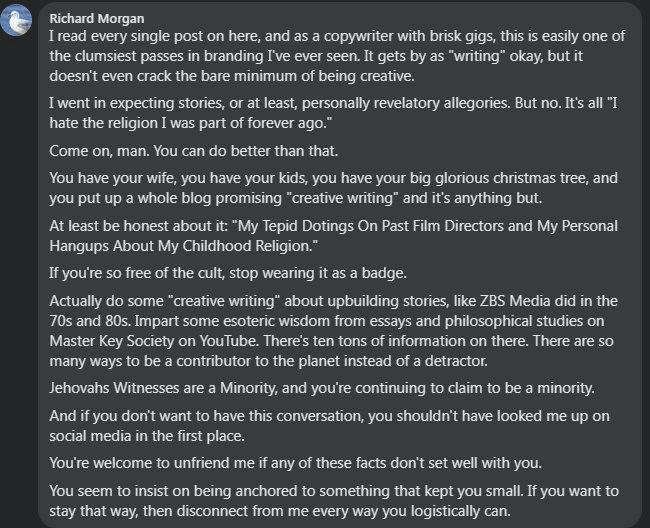
I have revised the Feedback Disclaimer on Random Creative Writing for clarification purposes. But I want to give Richard C. Morgan’s comments and feedback the attention that it deserves. The content is provided on a “take it or leave it” basis but “valuable and constructive feedback is welcome.” Still, there are some misconceptions which need to be addressed.
One, I am not attempting to “brand” or promote myself as a professional writer. I am not seeking financial compensation for providing content on a writing blog. Rather, I earn a decent salary in the healthcare industry. This includes “brisk gigs” as a freelance consultant for a law firm.
Two, I disagree with the professional copywriter’s assertion about creative content. According to Morgan, he is a Gatekeeper of Creative Writing. He determines when the “bare minimum of being creative” has been achieved. Also, he decides when authors can share their content with the planet.
In fact, many professional writers would disagree with Morgan. In her book, Foundations of Creativity, Mary Lee Marksberry references Paul Witty and Lou LaBrant’s Teaching the People’s Language. Marksberry uses this reference to explain the concept of Creative Writing. She notes that Witty and LaBrant … [say creative writing] is a composition of any type of writing at any time primarily in the service of such needs as
- the need for keeping records of significant experience,
- the need for sharing experiences with an interested group, and
- the need for free individual expression which contributes to mental and physical health.1
Additionally, B.J. Neblett, an author known for his work in Science Fiction, Fantasy, and Contemporary Fiction, spoke about significant life experiences. Neblett stated “we are the sum total of our experiences. Those experiences – be they positive or negative – make us the person we are, at any given point in our lives. And, like a flowing river, those same experiences, and those yet to come, continue to influence and reshape the person we are, and the person we become. None of us are the same as we were yesterday, nor will be tomorrow.”
Thus, Random Creative Writing is a website for artistic expression about positive and negative life experiences. The content is offered to readers who would like to know about my life and interests. The stories are presented without esoteric commentary or “personally revelatory allegories.”
Sadly, the Jehovah’s Witnesses will always be a significant detail of my life. Nevertheless, I am not wearing my escape from the Watchtower Society as a Badge of Honor. Most of my friends, family members, and professional acquaintances do not know about my religious experience. As a result, my involvement with the Jehovah’s Witnesses is a seldom known fact. Rather, it is an old scar from a healed wound. My experience highlights the traumatic consequences from religious indoctrination. Also, my story serves as a tragic reminder about the dangers of seeking absolute truth from a doomsday cult.
For twenty-five years, I have been capable of independent thinking while pursuing higher education and experiencing a successful career. Without embarrassment, I find enjoyment by pursuing hobbies and interests which were discouraged by the Jehovah’s Witnesses. For example, the group never supported my “tepid dotings” on science fiction and horror films.
Meanwhile, I married a beautiful and intelligent worldly woman. Deeply ingrained misogynistic attitudes and archaic courtship traditions are not needed in our relationship. Rather, we are equal partners in our marriage.
Together, we raise our wonderful and talented children to follow their own spiritual path. We do not force our own personal beliefs about God on them. Instead, we recognize various religious holidays and pagan customs. It is true that one custom is displaying our “big, glorious Christmas tree”2 in our living room. Ultimately, our family’s goal is to celebrate life together.
Honestly, Morgan can find enlightenment somewhere else. After all, there are “ten tons of information” in the world. If he is interested in scientific research and empirical evidence, I recommend a few topics for consideration. These include Cognitive Dissonance, Sunk Cost Fallacy, and the Behavior, Information, Thought & Emotional (BITE) Control Model. Also, he should study the Dialectical Method and Jungian Shadow Work.
But if Morgan demands allegorical stories with characters and situations, I recommend reading these critically acclaimed novels:
- Frank Herbert offered warnings about the manipulation of Religion, Messiahs, and Prophecies in Dune.
- Robert Heinlein explored the dangers of Fascist Organizations controlling Individual Freedom & Responsibility in Starship Troopers.
- George Orwell revealed the consequences of Propaganda, Group Think, Mass Surveillance, and Thought Reform in 1984.
Alternatively, there is a poetic way to explain how Morgan’s “minority” group belongs to a high-control, high-demand authoritarian religion. To illustrate, in Edith Wharton’s Souls Belated, a woman named Lydia is afraid of being socially rejected. Specifically, Lydia is terrified of being shunned by her social circle. As a result, she pretends to be married to her companion.
Lydia believes that the influential members of the group will emotionally blackmail her. Their undue influence causes emotional trauma to her well-being. The potential shunning convinces her into playing along with them. As a consequence, Lydia feels compelled to keep their secrets. The experience leaves Lydia upset and confused. Still, Lydia is guilty of accepting, approving, and condoning the rules. She reinforces the lies to be accepted.
Likewise, shunning is the primary method of emotional control used by the Jehovah’s Witnesses. Their members will avoid significant contact with anyone who leaves the group. Moreover, there are no exceptions to this rule.
A case in point, in the Summer of 1993, I became friends with Richard C. Morgan. He was a creative and stoic young boy. Our families attended the same congregation of the Jehovah’s Witnesses in my hometown.
In the Summer of 2008, I saw Morgan and his father in a local restaurant. Although it was years after my disassociation from the group, we had a brief conversation about our lives. I thought we parted ways on amicable terms.
On March 26, 2024, I sent Morgan a Friend Request on Facebook. We have mutual friends, both worldly acquaintances and inactive Jehovah’s Witnesses, on social media. He appeared to be going through some personal issues.
Originally, I was wanting to have an encouraging discussion with Morgan. I was holding out hope for his enthusiastic response to the Friend Request.
Instead, Morgan decided that offering criticism about Random Creative Writing was more important. He is correct that “there are so many ways to be a contributor” with creative content. But he projected his own anger, disappointment, jealousy, and resentment about my personal decision to resign from the group. Furthermore, Morgan did not offer sympathy or condolences about my parents. Truly, if he “read every single post on here,” then he discovered that both of my parents have passed away. Our fathers socialized with each other, and our families had dinner together.
Ultimately, it is beyond the pale for Morgan to belittle my existence. He condemns my experiences because I decided to be “free from the cult.”
If Morgan wants to pass judgment on my life choices, “then go right ahead. Do it if it makes you feel any better. I’m an easy target. Yeah, you’re right, I talk too much. I also listen too much. I could be a cold-hearted cynic like you…but I don’t like to hurt people’s feelings. Well, you think what you want about me; I’m not changing. I like me. My wife likes me. My [friends and family] like me. Cause I’m the real article. What you see is what you get.”3
Unfortunately, Morgan did not “want to have this conversation.” Rather, he blocked my account to “disconnect from me every way you logistically can.”
On April 14, 2024, three weeks later, Richard C. Morgan passed away at his home. It was very sudden, according to his family.
In the end, I am offering my sincere condolences to his family and friends. I hope Morgan lived the best life that he wanted and deserved.
FOOTNOTES
- Marksberry, Mary Lee. Foundation of Creativity. Harper’s Series on Teaching. (New York; London: Harper & Row, 1963), 39. ↩︎
- Jehovah’s Witnesses, known as Bible Students, celebrated Christmas until 1928. Conversely, my facial hair would have marked me as “spiritually weak” because it was considered a “worldly” grooming style. Now, beards are proudly worn by members of the congregation. This is because New Light from imperfect men approved the policy change. ↩︎
- Del Griffith, Planes, Trains, and Automobiles, 1987. ↩︎
 Random Creative Writing